

September 2026
How long does it take to charge an electric car at a rapid motorway charge point?
Using a rapid charge point of 150kW or more at a motorway service area, you can charge your electric car from 20% to 80% in about 30 minutes (model dependent). That's the perfect amount of time for a coffee or comfort break, recommended every 2–3 hours, especially on longer journeys.
If you’re used to petrol or diesel cars, you might wonder whether a long motorway trip in an EV is practical. It’s a common worry for drivers switching to electric.
But as of 2026, the UK’s public charging network has grown massively. With more than 119,000 public EV charge points, more than 27,000 of them rapid or ultra-rapid chargers, most motorway service areas are equipped with fast, reliable charging. The rapid expansion by networks like GRIDSERVE, Ionity, BP pulse, Osprey, InstaVolt, and Tesla Supercharger means the charging time is no longer a compromise, but a simple, efficient part of your journey planning.
What is a rapid charge point on the motorway?
Rapid DC charge points deliver 50kW or more DC power, right up to 350kW+, and can dramatically cut charging time compared to home or work charging.
The output of a charge point is measured in kW (kilowatts). The higher the number, the faster your car can charge, provided it can accept that level of power.
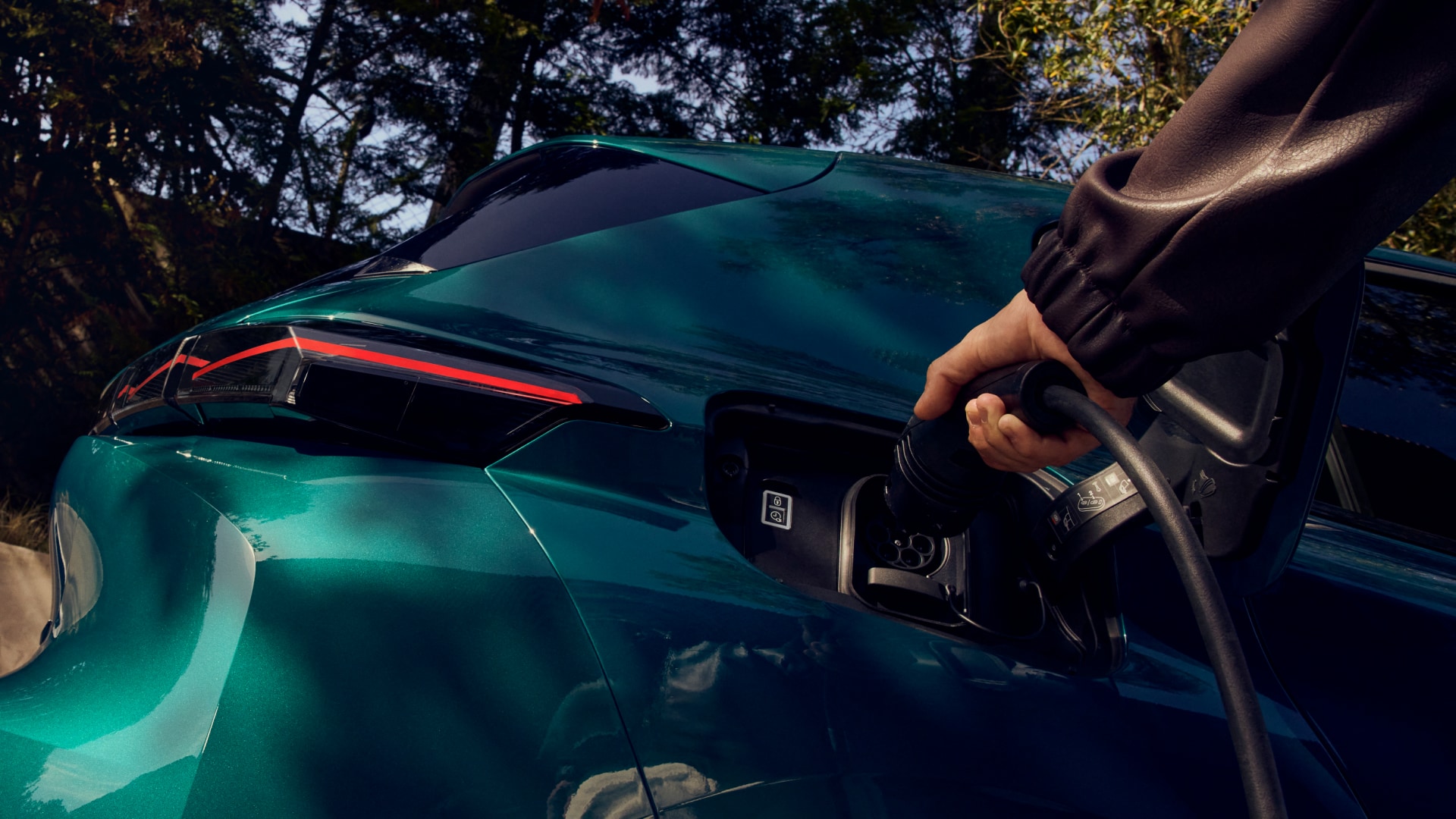
Most modern electric cars, including PEUGEOT models, charge using a CCS (Combined Charging System) connector, which is the UK and European standard for rapid and ultra-rapid motorway charging.
AC charge points, typically from 3kW to 22kW, are commonly found at home, at work and in public car parks. Rapid and ultra-rapid DC charge points, from 50kW upwards, are the preferred option for motorway top-ups, so you can top up in 30 minutes or less. Growth is significant: motorway and main road rapid charge sites now cover nearly all UK routes, making long EV journeys entirely practical.
No matter how powerful the charge point is, your car will only draw as much as its onboard charger allows.
Example: Even if you plug a car able to accept 150kW into a 350kW charge point, it will only ever take up to 150kW. The rest of the charge point's power remains unused.
How long do PEUGEOT electric cars take to charge at a motorway rapid charge point?
At a charge point of 150kW or higher, the PEUGEOT E-3008 and E-5008 Long Range recharge from 20% to 80% in just 27 minutes.
Smaller models such as the E-208 and E-2008 SUV take around 25 minutes for the same top-up.
These reference figures help protect your long-term battery health.
PEUGEOT is fully transparent about charge times and energy performance. All official UK figures below are based on an optimal rapid motorway charge between 20% and 80%.
PEUGEOT Electric Car Motorway Charge Times* (20–80%)
* All charging times are indicative and may vary according to vehicle version, battery temperature, charge point power, state of charge and environmental conditions.
As you can see, the latest PEUGEOT electric models deliver consistent, high-speed charging, even with different battery sizes, thanks to advanced engineering and the STLA Medium platform in the E-3008 and E-5008.
This means you don’t need to second-guess stops when planning family holidays, business trips or daily commutes. Just fit your top-up in with your next motorway service area break, without significantly changing your journey routine.
Why does charging slow down at 80% on the motorway?
Beyond 80%, charging speed drops, for all EVs, to protect your battery and avoid overheating. That’s why it’s both quicker and more efficient to top up to 80% before heading off again on the motorway.
After 80%, the onboard charging system (“Battery Management System” or BMS) automatically reduces power to safeguard the battery. For all lithium-ion EVs, forcing charge to 100% is less efficient, raising heat and slightly reducing long-term health.
Here’s how it works:
- 20% to 80%: Your battery draws maximum power from the charge point (up to 160kW on some PEUGEOT models). Keeping your charge between these levels gives peak efficiency and quickest stops.
- 80% to 100%: Charge power drops below 20kW. Adding the last 20% might take as long as the whole 20-80% session. For example, topping from 80% to 100% in a PEUGEOT E-3008 Long Range could add up to 40 minutes, more than your main top-up takes.
For the best motorway journey, experienced EV drivers recommend unplugging at 80% and hitting the road. Rapid charging coverage on major UK routes has improved significantly, but it is still best to plan your next stop before setting off, especially on longer or rural journeys.
Do motorway charging stops match UK road safety guidance?
Yes, road safety bodies recommend a break of 15 to 20 minutes every two hours. With most PEUGEOT rapid charges taking 25–30 minutes, you can recharge car and driver at the same time, perfect for family trips, business travel or holiday getaways.
The biggest psychological barrier for new EV drivers is fear of long waits during charging. In practice, with modern UK infrastructure, charge stops fit neatly into safety advice for breaks on long motorway journeys.
Fatigue causes up to 20% of motorway accidents (UK Road Safety stats). Regular breaks for food, drinks, and a stretch are always recommended. With your EV, you simply coincide a rapid top-up with your next coffee or comfort stop, no more excuses to skip rest breaks!
Example British Journey: London → Manchester (approx.210 miles)
- Start: Begin your road trip with a full battery, route planned via the onboard PEUGEOT i-Connect system or E-Routes App to easily locate motorway charge points.
- First Leg: After about 2–3 hours at up to 70 mph, your battery will likely be around 15–20%. Pull into a motorway service area equipped with rapid or ultra-rapid charge points.
- Break: Plug in (using a charge card/app or, on future PEUGEOT models, automatic Plug & Charge), take a comfort break, grab a snack, and have a coffee. In 27–30 minutes, your car is topped up to 80%, and you’re ready for the next leg.
- Second Leg: Continue your journey with confidence, cover the rest of your motorway journey without worrying about time wasted, motorway EV travel can now be planned confidently with the right charging tools
New for 2026: PEUGEOT E-308, E-308 SW, and E-408 models will support Plug & Charge, just plug in at compatible charge points and charging activates automatically, without using a separate RFID card or payment terminal, authentication and billing are handled automatically on compatible charge points.
How do pre-conditioning features on PEUGEOT E-3008 and E-5008 help with charging?
Pre-conditioning brings your battery to the ideal temperature before you reach the charge point, maximising charge speed even in winter or summer. For PEUGEOT E-3008 and E-5008, this comes as standard, just enter your route and the system works in the background.
Fast charging isn’t just about the charge point, it also depends on your battery’s temperature. For best performance, battery cells need to be at about 30–35°C. On cold UK mornings or after a summer drive, the onboard system automatically warms or cools the battery so you can charge at full power without delay.
Here’s how it works:
- Input your route: Your PEUGEOT i-Connect or E-Routes App plans your next stop, including where you’ll charge.
- Thermal calculation: The car’s computer predicts arrival time at your next motorway charge point.
- Dynamic pre-conditioning: 30–40 minutes before arrival, the system uses vehicle thermal circuits to pre-warm or cool the battery.
- Instant charge: Plug in, and your car immediately accepts maximum power, no waiting for battery to warm.
With PEUGEOT’s integrated pre-conditioning, your motorway charge times stay fast, whatever the British weather. The new E-408 offers this feature too.
100kW or 350kW: what size charge point do you need with your PEUGEOT electric?
PEUGEOT E-3008 and E-5008 Long Range can accept up to 160kW from a rapid DC charge point.
Confused by ultra-rapid, high-power charge points? Here’s the key, your car will only draw what it can handle. For most PEUGEOT EVs, that’s up to 160kW, so plugging into a 350kW unit (like those on GRIDSERVE or Ionity) is fine, but you’ll only take as much as your car needs for safe, healthy charging.
Charge Point Power Comparison (Real-World 20–80%)
PEUGEOT COMPATIBILITY NOTE: Maximum DC rapid charge for new PEUGEOT E-3008 and E-5008 is 160kW. Charging at a higher-power point won’t speed up your top-up, your PEUGEOT’s battery management will automatically keep things safe and healthy for the long run.
Both E-3008 Long Range and E-5008 Long Range are compatible with all UK DC rapid and ultra-rapid motorway charge networks, GRIDSERVE, Ionity, bp pulse, Tesla Supercharger, Osprey, InstaVolt and others. Plugging into a 350kW charge point is totally fine, the car will just take as much as it needs, with around 27 minutes for a 20–80% charge.