

July 2026

How long does it take to charge an electric car at a rapid motorway charge point?

At a rapid charge point, charging from 20% to 80% takes around 30 minutes, depending on the model. Conveniently, that's about the same amount of time as a coffee stop or comfort break, making it easy to recharge both your car and yourself on longer journeys. Here's a closer look at charging times for each model.
PEUGEOT E-308 SW profile view
Setting off on a long journey in an electric vehicle can raise questions, or even some apprehension, for drivers who have spent many years using petrol or diesel vehicles. By 2026, however, charging infrastructure has developed significantly to support electric mobility on a large scale. With increasingly dense coverage of ultra-rapid charging locations, charging time no longer has to be treated simply as a compromise: it can be incorporated into a smooth, straightforward and well-planned journey.
Electric cars Petrol and diesel cars
Charging at home
Can be charged at home using a suitable socket or wallbox
Refuelling available at fuel stations
Public charging
At the end of July 2026, there were 122,724 EV chargers, which are sited on 97,266 devices across 47,441 charging locations around the UK.  They support a range of charging use cases across on-street, destination and en-route charging. Source: Zapmap
There are roughly 8,349 to 8,400 operational petrol stations (fuel forecourts) in the UK.
Motorway stop duration
Around 30 minutes for a 20% to 80% charge
A break of at least 20 minutes is recommended every two hours
Number of charging locations: Zapmap UK

What is a rapid motorway charge point?

Rapid DC charge points deliver from 50 kW to more than 400 kW of direct-current power. Compared with home charging, they can dramatically reduce charging time. To understand why, it helps to clarify a few technical aspects of electric charging. An electric car’s charging power is measured in kilowatts (kW), and this influences how quickly the battery can be replenished.
Latest-generation electric cars can be charged using alternating current (AC) or direct current (DC). In Europe, they use a Combined Charging System, or Combo CCS, inlet. This accepts a Type 2 connector for AC charging, with two additional pins below it for rapid DC charging. CCS is the European standard used to support compatibility between vehicles and charging equipment. The connection used will depend on the type of connector available at the charge point.
AC charge points are the most common and can be found at home, at work and at lower-powered public charging locations. They typically deliver between 3 kW and 22 kW. DC charge points are considerably more powerful, ranging from 50 kW to more than 400 kW. High-power DC charge points are widely installed along motorway networks so that suitable vehicles can recharge in under 30 minutes. The number of DC charge points continues to grow rapidly across Europe. Whatever the charge point's rated output, the actual charging speed is limited by the maximum power the vehicle can accept. For example, at a 400 kW high-power charging station, a vehicle capable of accepting up to 150 kW will not be able to draw the station's full output and will instead charge at a maximum of 150 kW.

How long do Peugeot electric models take to charge on a motorway?

At a charge point rated at 150 kW or more, the Peugeot E-3008 and E-5008 Long Range can charge from 20% to 80% in 27 minutes. The Peugeot E-208 and E-2008 take around 25 to 27 minutes, depending on the version. These reference figures are based on an optimal rapid-charging cycle. PEUGEOT recognises that drivers moving to electric need reliable, standardised information, which is why the table below brings together the homologated charging data for the electric range. Actual charging time can vary according to the model, battery temperature, state of charge, charge point output and environmental conditions.

PEUGEOT electric vehicle charging-time table

Private vehicles Battery capacity (kWh) Maximum DC charging power (kW) 20% to 80% charging time
E-208 ELECTRIC 136
50
100
25 min
E-208 ELECTRIC 156
51
100
27 min
E-208 GTi ELECTRIC 281
51
100
27 min
E-2008 ELECTRIC 156
54
100
27 min
E-308 ELECTRIC 156
55
100
32 min
E-308 SW ELECTRIC 156
55
100
32 min
E-408 ELECTRIC 210
58
120
31 min
E-3008 ELECTRIC 210
73
160
30 min
E-3008 ELECTRIC 325 Dual Motor AWD
73
160
30 min
E-3008 ELECTRIC 230 Long Range
97
160
27 min
E-5008 ELECTRIC 230
73
160
30 min
E-5008 ELECTRIC 325 Dual Motor AWD
73
160
30 min
E-5008 ELECTRIC 230 Long Range
97
160
27 min
E-Rifter ELECTRIC 136
52
100
25,5 min
E-Traveller ELECTRIC 136
42
100
30 min
E-Traveller ELECTRIC 136 Long Range
69
100
45 min
Commercial vehicles Battery capacity (kWh) Maximum DC charging power (kW) 20% to 80% charging time
E-Partner ELECTRIC 136
52
100
30 min
E-Expert ELECTRIC 136
42
100
30 min
E-Expert ELECTRIC 136 Long range
69
100
45 min
E-Boxer ELECTRIC 270
98
150
55 min
These electric vehicle charging-time tables shows that, even with very different battery capacities, rapid-charging times across the PEUGEOT range remain relatively consistent. The STLA Medium platform used by the E-3008 and E-5008 is designed to accept a substantial amount of energy in a short period. This makes it easier to estimate the time needed for a charging stop when planning a family holiday or another long journey. Under suitable conditions, the time required to replenish the battery can fit naturally into a recommended motorway break, whether you are travelling alone or with passengers. Actual charging times vary according to the vehicle version, battery temperature, state of charge, charge point output and external conditions.

Why does rapid charging slow down above 80%?

Charging power slows above 80% to help manage cell temperature and protect the battery over time. Adding the final 20% can take disproportionately longer than an earlier part of the charging session, so on a motorway journey it may be more time-efficient to continue once the battery reaches around 80%. This behaviour is controlled by the Battery Management System, or BMS, which monitors the battery’s temperature, voltage and state of charge.

Charging behaviour at a glance:

From 20% to 80%

The battery can accept a high charging rate, (up to 160 kW). It is therefore more efficient to keep the battery’s charge level between 20% and 80%.

From 80% to 100%

The charging power drops below 20 kW. For example, charging the final 20% of an E-3008 Long Range’s battery takes approximately 40 additional minutes, which is longer than charging it from 20% to 80%.

On long journeys, making efficient use of your travel time often means following the approach used by experienced EV drivers: disconnecting at around 80% can allow you to continue whilst charging power has already begun to taper. With expanding rapid-charging coverage on major roads, it is not always necessary to charge to 100% at every stop. The right departure level still depends on the distance to the next compatible charge point, weather, traffic and the route planner’s estimate, so check live availability before relying on a particular location.

Can a motorway charging stop coincide with a recommended driving break?

Road-safety organisations and insurers commonly recommend taking a break of around 15 to 20 minutes after approximately two hours of driving. The 27 minutes required to charge a compatible Peugeot E-3008 or E-5008 from 20% to 80% can fit naturally into this rhythm. Charging time is often perceived as one of the main barriers to electric mobility. In practice, on a longer journey, a rapid-charging stop can coincide with a healthy rest break rather than create an entirely separate delay.
Driver fatigue is a recognised factor in motorway collisions (nearly 20% of fatal crashes). Stopping regularly to move, hydrate and restore concentration is an important part of safer long-distance driving. By combining a charging stop with a planned break, drivers can make practical use of the time rather than rushing through a brief fuel stop and setting off again immediately.

Consider a practical example: a Paris-to-Lyon journey of around 285 miles.

1. Departure

You leave home with the battery charged to 100%, having planned the route in advance through connected navigation or the e-ROUTES app to identify charge points along the journey.

2. First leg

After two hours and 15 minutes of driving at 70 mph, you take your first break at a motorway service area equipped with ultra-rapid charge points. The battery level has reached around 15% to 20%, depending on the weather and driving conditions.

3. Charging break

You activate the charge point using the Octopus Electroverse card, then connect the vehicle. In the time it takes to have a coffee, use the facilities and relax, around 25 to 30 minutes, the battery has recovered to 80% capacity.

4. Second leg

You set off again calmly for the second half of the journey, safely and without feeling that you have “lost” time waiting for the car.

How does battery pre-conditioning support rapid charging on the E-3008 and E-5008?

Battery thermal pre-conditioning, available on the E-3008, E-5008 and new E-408, brings the battery to its ideal temperature before reaching the charge point. This removes the need for the battery to warm up on arrival, helping to increase charging speed.
Charging performance depends not only on the motorway charge point, but also on the thermal condition of the battery at connection. To accept high power from the first few seconds, the battery cells need to be within a very precise temperature range, ideally between 30°C and 35°C. In winter, a cold battery limits the power it accepts in order to protect itself. Conversely, it may need cooling after a long period of high-speed driving in hot weather. This is where the intelligent thermal management integrated into Peugeot electric cars comes into its own. The standard active thermal pre-conditioning system on larger Peugeot electric models operates automatically:
Integrated route planning
Enter the journey in the PEUGEOT i-Connect Advanced on-board navigation system or the e-ROUTES app.
Thermal calculation
The on-board computer calculates the exact arrival time at the next charging station selected by the planner.
Dynamic adjustment
Around 30 to 40 minutes before the stop, the system uses the vehicle’s thermal circuit to heat or cool the battery actively.
Connect and charge
As soon as the motorway charge point’s CCS connector is inserted, the car immediately accepts its maximum power without a waiting phase.
This system guarantees consistent advertised charging times in all weather conditions, from winter cold to summer heat.

100 kW or 350 kW: what charging power does your Peugeot electric car need?

The Peugeot E-3008 and E-5008 Long Range can charge at up to 160 kW using a DC rapid charger. A common misconception is that ultra-rapid charge points rated at 300 to 400 kW will always charge a vehicle faster. In practice, charging speed is determined by both the power delivered by the charge point and the maximum power the vehicle can accept.

Charging comparison by charge point power

Charge point power Current type Maximum power delivered to the vehicle Indicative 20% to 80% time Battery considerations
50 kW
DC
Up to 50 kW, charge point limited
Approx. 1 hr 15 min
Managed by the vehicle
100 kW
DC
Up to 100 kW, charge point limited
Approx. 35 minutes
Managed by the vehicle
150 kW
DC
Up to 150 kW, subject to the vehicle charging curve
Approx. 29 minutes
Managed by the BMS
300 kW
DC
Up to 160 kW, vehicle limited
Approx. 27 minutes
Managed by the vehicle
Peugeot compatibility note: the maximum DC power accepted by the Peugeot E-3008 and E-5008 is 160 kW. The vehicle automatically and safely adapts the power received to protect the battery. Using a charge point rated above 160 kW will not charge the vehicle any faster.
The Peugeot E-3008 Long Range and E-5008 Long Range are compatible with all rapid DC charge points available on UK motorways. Both vehicles make full use of charge points rated at 150 kW or more. Connecting to a 350 kW charge point, such as those on the IONITY network, is entirely possible and highly recommended for session stability; the vehicle automatically limits the energy input to 160 kW. This technical protection preserves cell integrity over the long term while ensuring a very short stop of around 27 minutes.

Discover the Peugeot electric range and connected mobility solutions

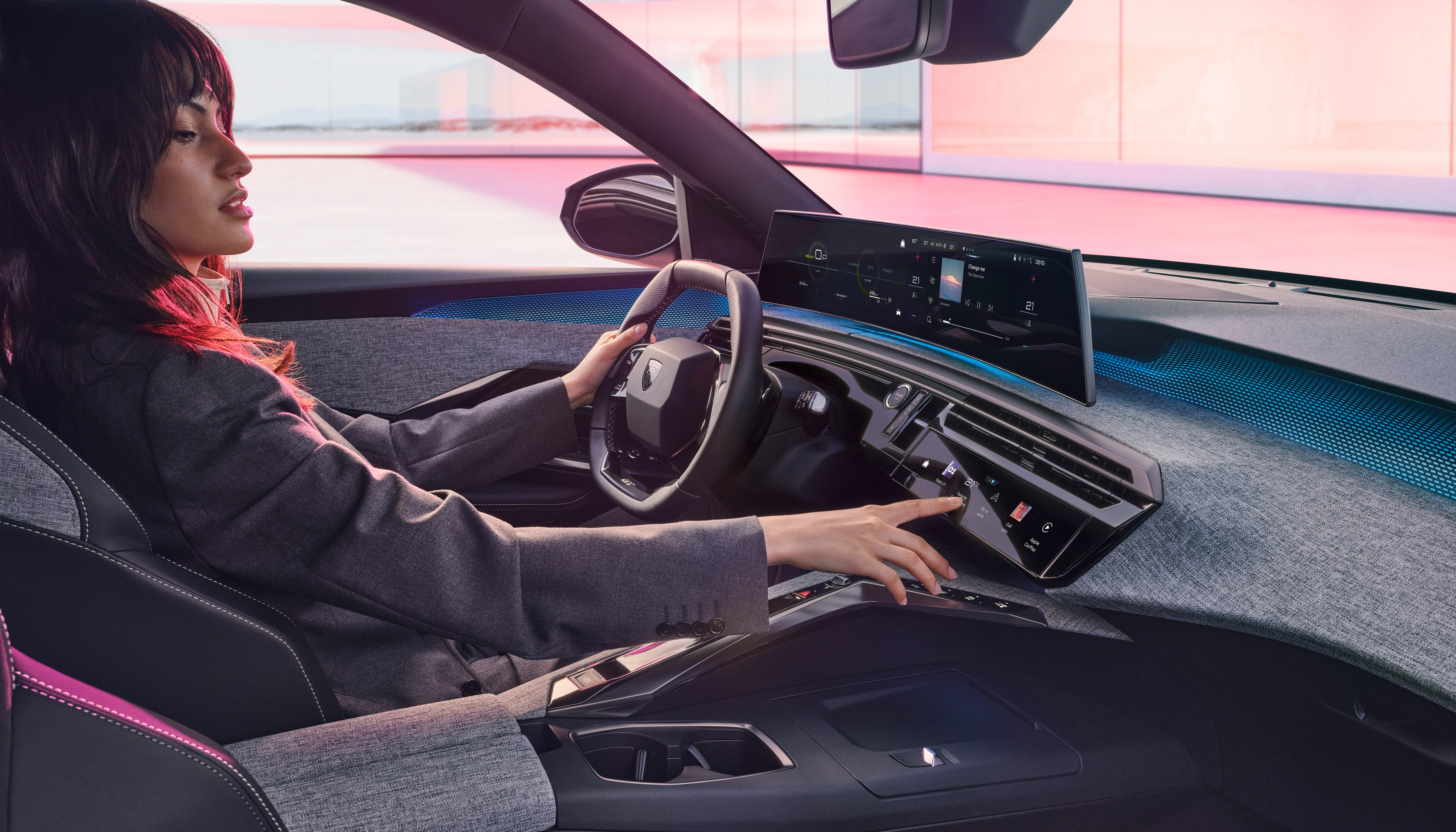
Peugeot designs solutions to simplify every aspect of electric driving. From our latest long-range SUVs to the intuitive ergonomics of PEUGEOT i-Cockpit® and PEUGEOT Panoramic i-Cockpit® on the E-3008 and E-5008, everything is designed to offer optimum driving comfort on long journeys. With the Octopus Electroverse app, you have simplified access to a major European network, helping you plan journeys with confidence.
PEUGEOT range

Configure your E-3008 fastback SUV

Explore your charging solutions